Prove Set of Points Where F is Continuous is G Delta Set
Set of discontinuous points
The set of point of continuity is a $G_\delta$ set. So the points of discontinuity is $F_\sigma$. $F_\sigma$ sets are certainly Borel.
To see this: Let $C$ be the set of points of continuity of $f$. Define $\text{osc}_f(x) = \inf \{\text{diam}(f(U)) : x \in U \text{ and } U \text{ is open }\}$. Note $f$ is continuous at $x$ if and only if $\text{osc}_f(x) = 0$. Show that for each $\epsilon$, the set $E_\epsilon = \{x : \text{osc}_f(x) < \epsilon\}$ is open. Then $C = \{x : \text{osc}_f(x) = 0\} = \bigcap_n E_{\frac{1}{n}}$. So what you called $A = \mathbb{R} - C$ is $F_\sigma$.
The oscillation is just how small the image an open set containing $x$ can be made. Suppose $f$ is continuous at $x$, then for all $\epsilon$, there exists a $\delta$ such that $|f(x) - f(y)| < \epsilon$ whenever $|x - y| < \delta$. This means that $\operatorname{diam}((x - \delta, x + \delta)) < 2\epsilon$ (use triangle inequality). So $\operatorname{osc}_f(x) < 2\epsilon$. Since $\epsilon$ is arbitrary, $\operatorname{osc}_f(x) = 0$. Conversely suppose $\operatorname{osc}_f(x) = 0$. Then for all $\epsilon$, there exist an open set $U$ containing $x$ such that $|f(a) - f(b)| < \epsilon$ if $a,b \in U$. Choose $\delta$ such that $(x - \delta, x + \delta) \subseteq U$. Then if $|x - y| < \delta$, $|f(x) - f(y)| < \epsilon$. So $f$ is continuous.
Related videos on Youtube
10 : 10
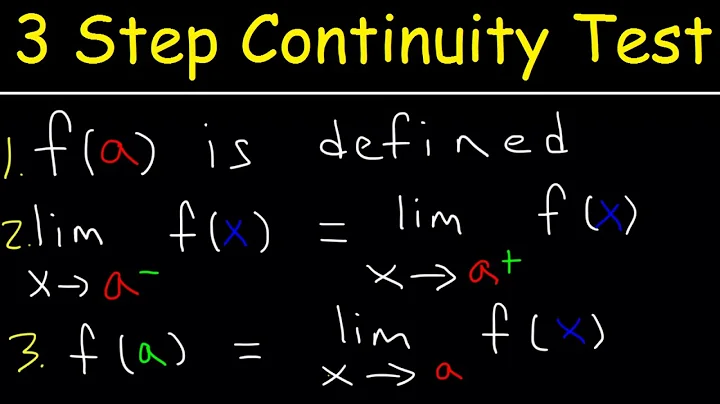
3 Step Continuity Test, Discontinuity, Piecewise Functions & Limits

13 : 31
Continuity Basic Introduction, Point, Infinite, & Jump Discontinuity, Removable & Nonremovable

02 : 07
Learn how to find and classify the discontinuity of the function

08 : 50
![f is bounded & set of points of discontinuity of f has a finite no. of limiting points is R[a,b]](https://i.ytimg.com/vi/016n_iUyAjE/hq720.jpg?sqp=-oaymwEcCNAFEJQDSFXyq4qpAw4IARUAAIhCGAFwAcABBg==&rs=AOn4CLBd4T1M0HcTFS9xUVmK2xiXhiAO3A)
10 : 24
f is bounded & set of points of discontinuity of f has a finite no. of limiting points is R[a,b]
Comments
-
Suppose $f$ is function from $\mathbb{R}$ to $\mathbb{R}$. Let be the set $\mathbf{A}$ that contains all the discontinuous points of $f$.Is $\mathbf{A}$ Borel Measureable?
-
What do you know about the set of continuity points?
-
you know nothing. You only know that $f$ is a random function and $\mathbf{A}$ is the set of discontinuous points of $f$.
-
Huh? (also, are you paying your ISP by the amount of characters you type? If not, please write
youinstead ofu; if yes, then this is 2013 and surely you can find a better deal.) -
@Asaf Karagila. You know nothing. You only know that $f$ is a random function and$\mathbf{A}$ is the set of discontinuous points of $f$. But i think you can assume there is a set of continious point.
-
An empty set of continuity points is still a set. I was trying to point out the fact that the set of continuity points is always Borel, so its complement must be Borel too.
-
The set of discontinuity is the complement of the set of continuity points. So to solve your question it, suffices to show that the set of continuity points is Borel.
-
See also here, here. Other questions listed among linked posts there can be also interesting for you.
-
-
can u explain in words what that osc means? and why is osc=0 iff f continious.
-
@user95525 I added some more explanation to the answer.
-
But how do i show that C is Borel?
-
@user95525 I showed above that $C$ is $G_\delta$, which means it is a countable intersection of open sets. $G_\delta$ sets are Borel. You do know that the collection of Borel sets contain the open sets and are closed under complements and countable intersection?
-
Im following the course Measure theory and i find it very difficult. I forgot that the collection of Borel sets contain the open sets and are closed under complements and countable intersection.
-
@user95525 You can find some basic things about oscillation of a function on Wikipedia. Maybe that can help you, too.
-
@William can you please explain why is $E_\epsilon = \{x : \text{osc}_f(x) < \epsilon\}$ open ? I know that inverse image of an open set is open for continuous function, but here I think we don't know whether $\text{osc}_f(x)$ is continuous or not.
-
@NeerajBhauryal In metric spaces, a set is open if every point in the set has an open ball contained in the set. Use this definition to prove the set is open.
-
@William could you please show how it is done, I'm not able to do it. Moreover if we show it is true for all $\epsilon$ then won't this imply that $\text{osc}_f$ is continuous ? which is not true in general!
-
@William thanks for the answer. A small typo. It was writtten as $\operatorname{diam}((x - \delta, x + \delta)) < 2\epsilon$ but should be $\operatorname{diam}(f(x - \delta, x + \delta)) < 2\epsilon$.
Recents
Related
Source: https://9to5science.com/set-of-discontinuous-points
0 Response to "Prove Set of Points Where F is Continuous is G Delta Set"
Post a Comment